0207 870 1221

Key Takeaways
Transitioning to a psychologically informed model transforms how we support residents with complex needs. Our approach focuses on long-term safety, staff wellbeing, and systemic change within our hostels.
-
Understanding the psychological impact of trauma is foundational to our work.
-
Small physical changes to hostels can significantly reduce resident stress levels.
-
Reflective practice sessions are essential for maintaining a supported and effective staff team.
-
Implementing these environments requires sustained commitment from all organizational stakeholders.
-
Success is best measured by tracking both staff wellbeing and service user feedback.
Defining psychologically informed environments in the homelessness sector
When we adopt a framework that prioritizes the emotional needs of our service users, we move toward a more compassionate way of operating. Taking the time to understand the psychological makeup of those we serve helps us offer higher quality care. By integrating this focus into our daily routines, we create spaces where long-term healing is actually possible.
The origin and core concepts of PIE
The fundamental idea behind this model is that every interaction can be a therapeutic moment if we approach it with intention. We look at the history, biology, and current emotional state of our guests to guide our interventions. It is about shifting our perspective from merely managing housing to actively creating environments where people feel safe enough to change.
Distinguishing PIE from clinical therapy
It is important to clarify that we are not trying to replace formal mental health services with our hostel staff. Instead, we use a trauma-informed approach to inform all our interactions without requiring clinicians to be present at every turn. We provide a steady, supportive presence that complements external therapy rather than attempting to duplicate its clinical functions.
The importance of psychological awareness in social care
We often see how past adversity affects how residents engage with our services and maintain their tenancies. By using trauma-informed care as a lens, we can interpret difficult behaviours as survival strategies rather than deliberate defiance. This awareness changes our internal culture, allowing us to respond with patience rather than frustration when things become difficult.
The key elements of a PIE framework

Building a successful environment requires us to look at everything from our physical layout to our staff training protocols. We know that consistency is the bedrock of trust, especially for those who have experienced chronic instability. By balancing these elements, we create a structure that supports both service user growth and staff resilience.
Developing consistent staff training and support
Our teams need specialized tools to feel confident while working with complex trauma and behavioural challenges. We prioritize ongoing education to ensure every staff member feels capable of navigating difficult conversations. We typically use a tiered approach to training:
-
Understanding the physiological impact of trauma on decision-making.
-
De-escalation techniques that prioritize emotional safety over control.
-
Techniques for sustaining personal resilience during high-pressure shifts.
-
Identifying when to refer service users to specialized mental health resources.
This training loop ensures that our team remains aligned, prevents confusion during crises, and ultimately creates a more consistent and compassionate experience for our residents.
Designing physical spaces for healing and calm
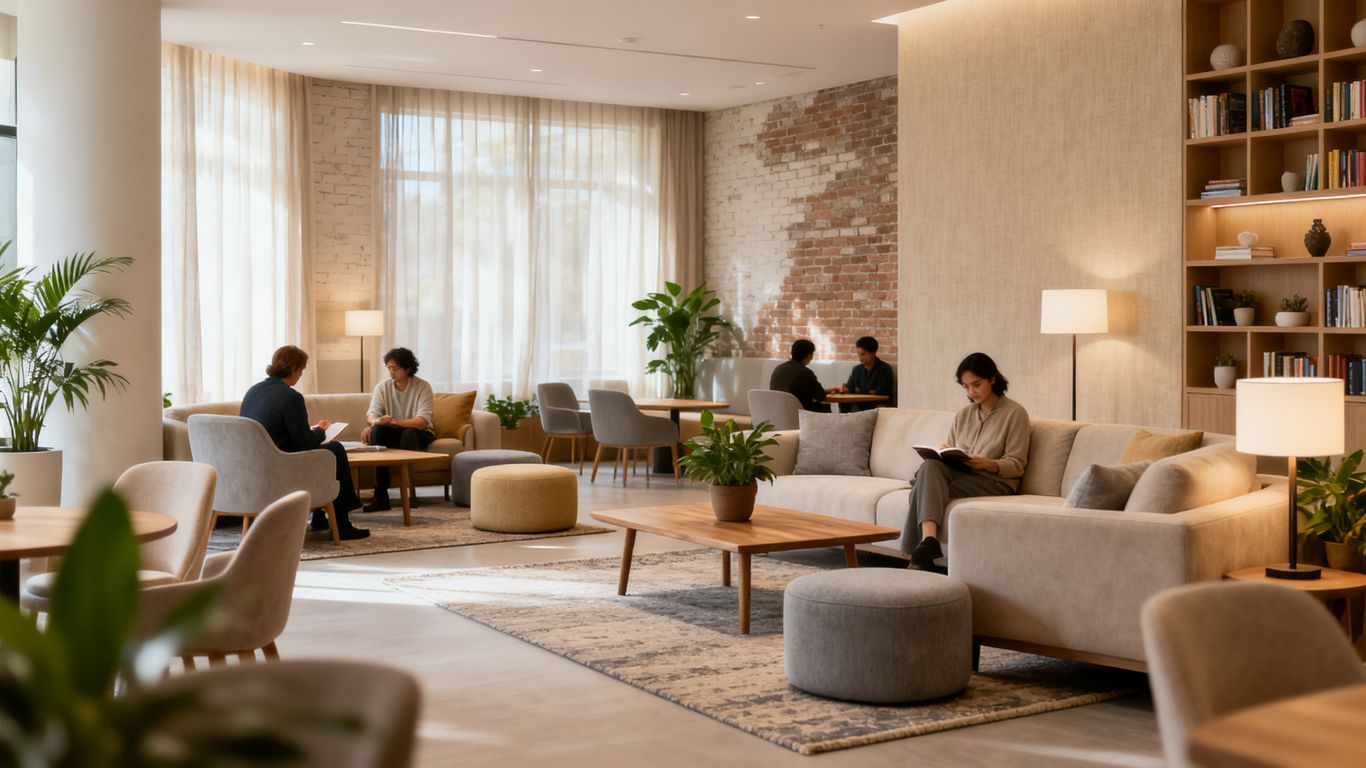
Our physical environment plays a massive role in how people regulate their emotions on a daily basis. We strive to create interiors that help residents feel secure and in control of their own space.
A well-designed environment acts as a silent therapist, lowering cortisol levels by providing quiet, predictable areas that allow residents to decompress away from the chaos of street life.
Small adjustments like soft lighting, clear wayfinding, and zones for social interaction can make the difference between a high-stress ward and a genuine home for those seeking refuge.
Promoting social interaction and community building
We encourage residents to engage in activities that build their confidence without demanding immediate recovery. By facilitating social groups and communal meals, we help break the cycle of isolation. This foster a sense of belonging that is crucial for maintaining a successful tenancy over the long term.
Evidence generation through reflective practice
We rely on reflective practice groups to analyse our interactions and refine our approach continuously. This process allows us to step back, examine why specific incidents happened, and plan better for future scenarios. It is not just about incident reporting; it is about learning from the nuance of every complex human connection.
Why PIEs are essential for homeless hostels
Many of our residents carry the weight of years of systemic exclusion and personal hardship. When we ignore these factors, we often fail to provide the stability required for them to move forward. Integrating a psycho-social framework allows us to address the root causes of disengagement while staying focused on our mission.
Addressing the legacy of complex trauma
We must acknowledge that survival modes built over many years do not disappear the moment someone walks through our doors. By tailoring our support to the reality of complex trauma, we build bridges rather than walls.
Reducing institutionalisation and stress
Standard hostel models can sometimes unintentionally reinforce a sense of powerlessness among residents. We combat this by giving people autonomy over their spaces and decisions. Providing choices, however small, helps decrease feelings of stress and builds the agency needed for independent living.
Improving engagement with support services
Residents are much more likely to follow through with support plans when they feel heard and respected. We use a relational approach to build trust, ensuring that service users view us as partners rather than gatekeepers. This relational focus naturally leads to higher completion rates for essential support interventions.
Managing challenging behaviours constructively
Rather than resorting to immediate punitive measures for rule violations, we use incidents as learning opportunities. We investigate the underlying needs that prompted the behaviour and adapt our support plan accordingly. This keeps people housed and prevents the revolving door of evictions that often plagues traditional services.
Implementing a psychologically informed environment in your hostel

Making the shift requires a deliberate, iterative process that involves everyone from management to the front-line workers. We want to start by assessing what we already do well and where we have significant gaps. Success is built on buy-in and a clear, shared vision for the future of the service.
Conducting a psychological environment assessment
We begin by auditing everything from our intake processes to our physical environment. We look for barriers that might prevent residents from feeling safe or understood. Our goal is to create a baseline that allows us to track real improvements over the coming months and years.
Getting buy-in from staff and stakeholders
Without a culture shift, the best handbook will fail to gain any real traction. We involve our staff in the planning stages so that the model reflects the realities of their work. When everyone understands the ‘why’ behind these changes, we generate the commitment needed for long-term project viability.
Establishing regular reflective practice sessions
These sessions are our most vital tool for supporting our staff team and maintaining our therapeutic integrity. We dedicate time every month for small groups to discuss their work in a safe format. This allows us to process the emotional burden of the job and share what is actually working with our residents.
Continuous monitoring and iterative improvement
We know that we must constantly update our approach based on new data and staff feedback. We view this as an ongoing journey of learning where we never stop refining our methods. For those looking to track their progress, evaluating impact remains a central pillar of our ability to grow and adapt effectively.
Overcoming common challenges in PIE adoption
Change is never without resistance, and we often find that our existing systems are not perfectly aligned with our new goals. Navigating these obstacles is part of the work, and we stay committed by focusing on small, incremental wins. We ensure that our goals remain realistic and grounded in the daily reality of the hostel.
Balancing security needs with therapeutic goals
We maintain safety without sacrificing our relational focus. High security and a therapeutic approach can coexist if we focus on mutual respect and clear boundaries. We find that when residents feel safe, the need for intrusive surveillance naturally decreases.
Managing high staff turnover and burnout
Burnout is a risk in any care-based profession, particularly when dealing with complex trauma. By investing in regular reflective practice and providing strong consistent supervision, we help our staff stay in the sector longer. Valuing our team’s emotional health is an investment in the stability of our residents.
Navigating budget and resource constraints
We focus on low-cost, high-impact changes that don’t depend on large funding injections. Often, it is a change in culture — such as how we phrase our requests or how we decorate communal rooms — that makes the biggest difference. We look for creative ways to repurpose our current budget toward therapeutic goals.
Ensuring consistent approaches across multi-disciplinary teams
We work hard to align our external partners with the same guiding principles we use in-house. When everyone — from housing officers to social workers — speaks the same language, the resident experiences a cohesive support network. This consistency is vital for preventing mixed messages and building trust.
Measuring the success of a psychologically informed environment
We need to know if our efforts are actually helping those we support. We focus on a blend of quantitative data and individual stories to paint a full picture of our impact. It is about understanding what methods lead to real, sustainable change for our residents.
Using outcome-based tools to track progress
We use validated metrics to measure shifts in resident wellbeing and engagement. These tools provide a clear way to see if our interventions are hitting the mark. Tracking this data over time allows us to demonstrate the value of our work to commissioners and stakeholders.
Gathering qualitative feedback from service users
The most important data often comes from direct conversations with those living in our hostels. We prioritize finding out if they feel safe, respected, and heard in their daily environment. Their experiences are the most accurate indicator of whether we are hitting our goals.
Assessing staff satisfaction and wellbeing metrics
We regularly survey our team to ensure our internal support systems are working. When our staff feel well-supported, they are more capable of offering high-quality care to our residents. We treat staff satisfaction as a primary indicator of our service health.
Analysing reductions in incident reports and hostel evictions
We look for tangible decreases in the most destabilizing events, like evictions and serious incident reports. A reduction in these areas suggests our PIE approach is successfully preventing crises before they escalate. This stability is the true measure of our success.
Conclusion
By fully committing to a psychologically informed model, we create far more than just a place to sleep; we build a foundation for recovery and long-term stability for our residents. This approach is not a finish line but a culture of continuous learning and empathy that allows us to better support the people who need us the most.
Frequently Asked Questions
Are psychologically informed environments suitable for every type of hostel?
While every service varies in resources, the core principles of understanding trauma and supporting staff can be adapted to any setting. Our approach is scalable and focuses more on the quality of interactions than on expensive upgrades or physical premises.
How long does it typically take to see results after implementation?
Because we are changing culture rather than just policy, results often emerge gradually over six to twelve months. Small improvements in staff morale and resident engagement are usually the first signs that the environment is shifting in a positive direction.
Do staff need to be psychologists to work in a PIE hostel?
No, you do not need a clinical qualification, but you do need an openness to learning about psychological principles. We focus on giving our team the tools to apply psychological awareness in their daily work, which is very different from providing professional therapy.
What happens if a resident refuses to engage with our support services?
We respect their choice while maintaining a kind, consistent presence in their lives. We continuously offer support in small, non-demanding ways, knowing that trust takes time to build, especially for those who have been let down by systems in the past.
How does a PIE shift the way we handle rule violations?
We move from a punitive model to an investigative one, asking what unmet need or past trauma triggered the behaviour. This reduces reflexive evictions and keeps service users engaged with the support they actually need.
Is this approach too expensive for small charities to adopt?
By focusing on staff culture, communication styles, and reflective practice, we can implement many PIE elements with very little extra funding. The most important resources are a shift in mindset and a commitment to regular, supported reflection.
Can family members of service users play a role in this environment?
Engaging with support networks is a key part of our relational approach. We encourage healthy connections where possible, provided they support the safety and long-term goals of the resident in a way that aligns with our environment.