0207 870 1221

Key Takeaways
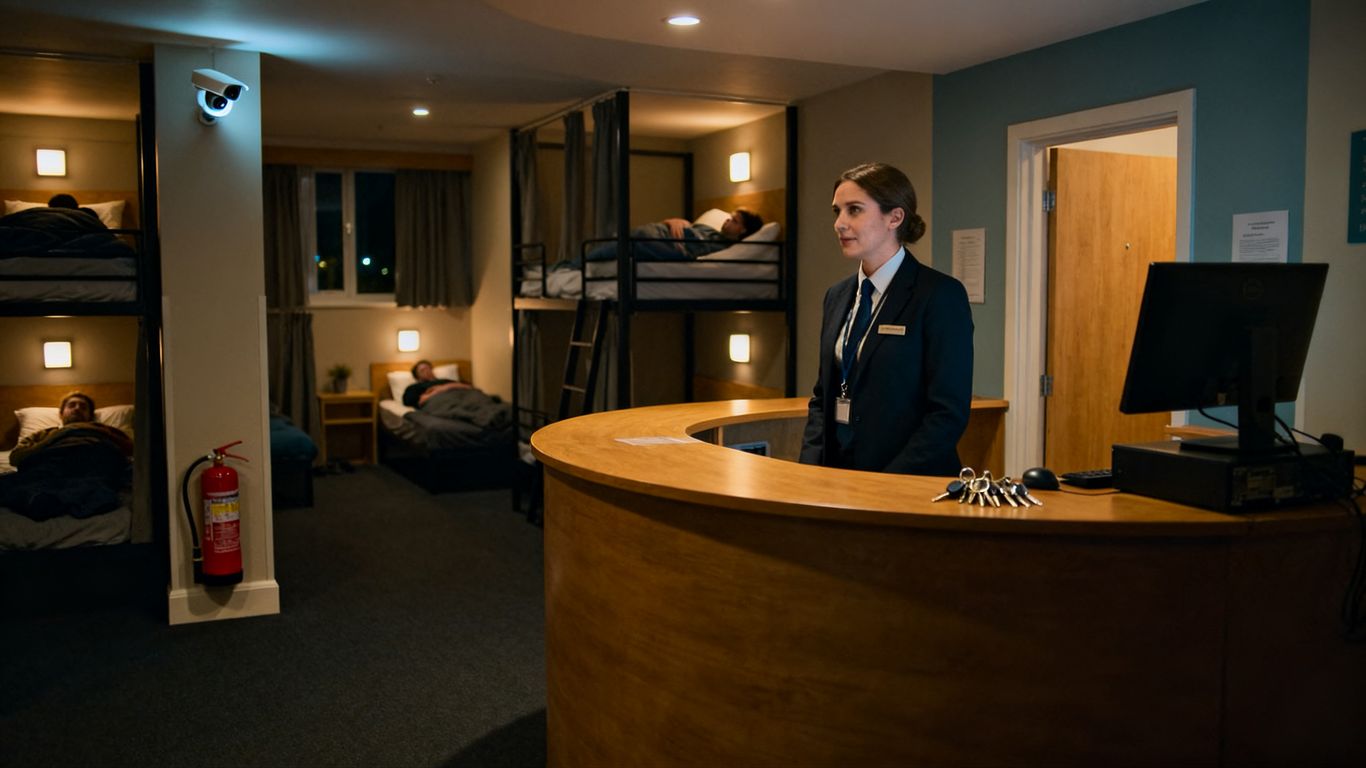
A capable night concierge combines hospitality, sound judgement and practical safeguarding skills. Good concierge training prepares us to work calmly and consistently when fewer colleagues and services are available.
-
Understand how overnight hostel work differs from daytime operations.
-
Build respectful communication, de-escalation and accessibility skills.
-
Learn access control, incident reporting and emergency procedures.
-
Use hostel systems accurately, even during busy or difficult shifts.
-
Refresh training regularly through practice, feedback and review.
Understand the role and responsibilities of a night concierge
Night work in a hostel is more than sitting at a desk until morning. We may welcome late arrivals, respond to residents, protect the building and make sensible decisions without an immediate manager nearby. The right concierge training therefore combines service, security, independence and care.
How the night shift differs from daytime hostel operations
During the day, teams are usually larger and external services are easier to reach. At night, the concierge may be the most visible member of staff, dealing with arrivals, noise, welfare concerns and building checks in a quieter setting. We need to understand which issues can wait until morning and which require immediate action.
The role can involve long calm periods followed by a sudden incident. Training should prepare us to remain observant without becoming intrusive, and to keep records even when the shift has otherwise seemed uneventful.
Balancing guest service, supervision and independent decision-making
A night concierge should be welcoming without losing sight of safety. We need to decide when to reassure someone, when to ask for more information and when to escalate to a manager or emergency service. Clear procedures help us act confidently rather than relying on guesswork.
HHS Group role information describes overnight duties such as responding to resident needs, monitoring for anti-social behaviour and carrying out security checks. Those responsibilities show why patience and practical judgement belong together in the role.
Building knowledge of the hostel, local area and transport options
We should learn the building room by room: entrances, exits, fire points, first-aid supplies, staff-only areas, accessible routes and isolation points. Local knowledge matters too. A concierge may need to explain late transport, pharmacies, hospitals, police stations or safe routes without giving uncertain advice.
A useful induction includes a walk-through at night, when lighting, noise and access patterns may differ from the daytime view. We should also know which local services are available out of hours and which must be contacted through an agreed internal process.
Setting clear boundaries around authority and personal safety
Training should make our authority clear. We can apply house rules, control authorised access and report concerns, but we should not present ourselves as a police officer, clinician or support worker unless we hold that role and training. Personal safety comes first, particularly when working alone.
We should know how to withdraw from a situation, summon help and record a concern without unnecessarily confronting someone. Calm boundaries protect everyone: guests, colleagues and the concierge themselves.
Build strong guest service and communication skills
The night concierge often shapes a guest’s first or last impression of the hostel. We need to be warm, concise and considerate of people who may be tired, anxious or unfamiliar with the building. Service training should also recognise that a hostel can include people with very different needs and expectations.
Welcoming late arrivals without disturbing sleeping guests
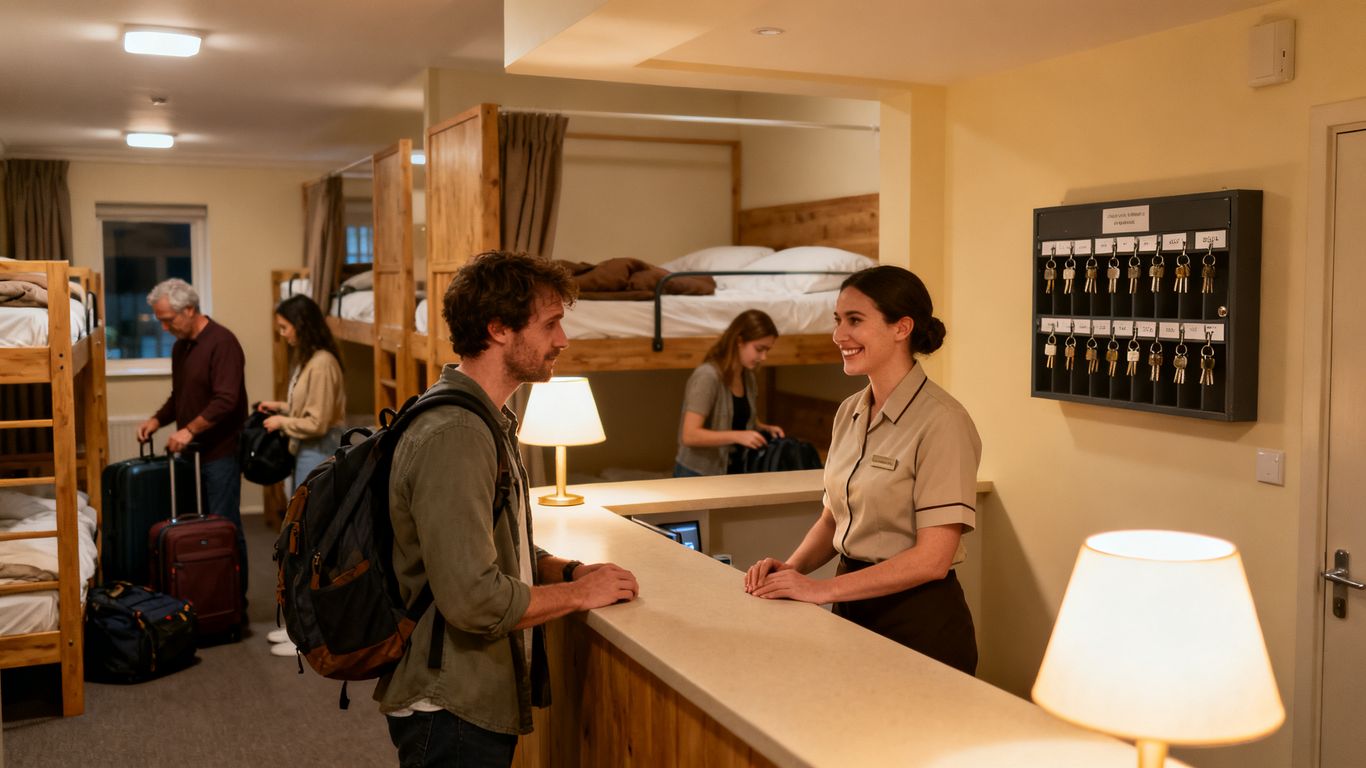
Late check-ins should be handled quietly and efficiently. We can confirm identity and booking details, explain the essential rules, show the route to the room and avoid unnecessary conversation in sleeping areas. A prepared late-arrival process reduces noise and prevents the guest from feeling rushed or unwelcome.
We should also know what to do when a reservation cannot be found, payment is incomplete or the allocated bed is unavailable. The answer should follow the hostel’s procedure rather than an improvised promise.
Handling complaints, conflict and challenging behaviour calmly
Complaints often become harder when someone feels ignored. We can listen without interrupting, acknowledge the practical issue and explain what we can do next. If behaviour becomes threatening, the priority changes from service recovery to safety and escalation.
The basic sequence should be practised, not merely described: keep space, use a steady voice, avoid arguing about pride or blame, and call for support early. HHS Group describes de-escalation and incident management in its night security concierge roles, both of which are useful areas for practical training.
Communicating across language, cultural and accessibility differences
We should avoid assuming that a quiet guest understands every rule or that a direct communication style means hostility. Plain language, patience, visual directions and approved translation support can make instructions easier to follow. Accessibility training should cover physical access as well as hearing, vision, cognitive and communication needs.
A concierge must also know when to ask a colleague or service for assistance rather than pretending to understand. Respectful clarification is safer than a confident misunderstanding, especially around evacuation, medication or room access.
Providing discreet, professional support to solo and vulnerable travellers
Some guests may arrive frightened, distressed, intoxicated or unsure where to turn. We can offer practical help, protect privacy and follow safeguarding procedures without making promises outside our role. A private conversation should take place in a safe, observable setting where possible.
We should never treat vulnerability as an invitation to investigate someone’s personal history. Our task is to notice concerns, respond proportionately and pass information to the appropriate person through the agreed channel.
Develop essential safety and security awareness
Security at a hostel is built from small, repeated actions. We need to understand who may enter, how access is recorded, what a normal night looks like and how to report something that does not fit. Training should be practical enough to use under pressure, while keeping residents’ dignity intact.
Controlling access, keys, entry systems and visitor permissions
We should learn the rules for issuing keys, checking identity, authorising visitors and managing lost or unreturned access devices. Staff-only areas, contractor access and emergency entry should each have a clear process. A friendly approach does not mean bypassing controls.
Practice should include common exceptions: a guest locked out, a visitor who knows a resident’s name, a damaged key card or a person asking to be admitted on someone else’s behalf. Each case should end with a documented and proportionate decision.
Recognising suspicious behaviour and safeguarding concerns
Suspicion should be based on observable behaviour, not appearance, nationality, disability or social background. We might notice repeated attempts to enter restricted areas, coercive behaviour, unexplained distress or a safeguarding disclosure. The response should be factual, non-accusatory and consistent with policy.
We should know the difference between gathering enough information to keep someone safe and conducting an amateur investigation. Where concern is serious, immediate escalation is more appropriate than prolonged questioning.
Completing patrols, handovers and incident records consistently
Patrols work best when they have a defined route, frequency and purpose. We should check agreed areas, note defects or unusual activity and record the time accurately. Incident logs should distinguish what we saw and heard from what we assumed.
A short checklist can keep routine work dependable:
-
Confirm entrances and restricted doors are secure.
-
Check agreed communal and external areas.
-
Record alarms, defects, disturbances and follow-up actions.
-
Pass urgent information to the correct contact.
The checklist is not a substitute for judgement. It is a prompt that helps us notice patterns and gives the next shift a reliable account of the night.
Protecting guest data, belongings and personal information
We may see booking details, room numbers, contact information, payment records or sensitive conversations. That information should only be accessed and shared for a legitimate work purpose. We should keep screens, keys, paperwork and conversations away from unauthorised people.
Training should also cover found property, requests from callers and messages left for guests. A polite refusal to disclose private information is part of good service, not a failure to help.
Prepare for emergencies and first-response situations
A night concierge is not expected to replace the emergency services, but we may be first to notice a fire, injury, serious conflict or welfare crisis. We need clear instructions, regular practice and the confidence to call for help early. Good preparation reduces hesitation when the building is unfamiliar in darkness or under stress.
Following fire safety, evacuation and alarm procedures
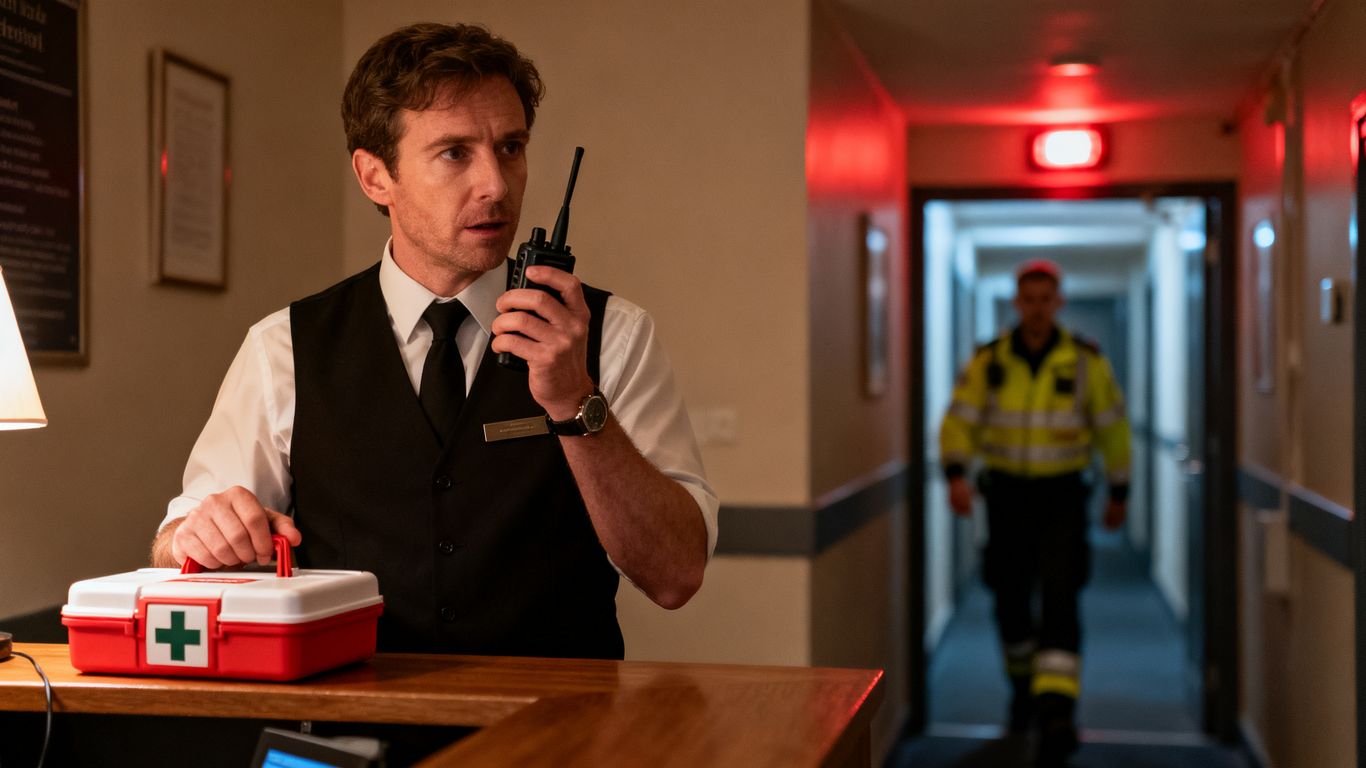
We should know the alarm sound, escape routes, assembly point, refuge arrangements and the limits of our responsibility during evacuation. Training needs to account for sleeping guests, mobility needs, locked doors and people who may not understand an announcement.
We must never re-enter a building or delay an evacuation to retrieve belongings unless emergency professionals instruct us to do so. Rehearsing the procedure at different times of night helps expose practical problems before an incident.
Responding to medical incidents and knowing when to call for help
Our response should begin with personal safety, a quick assessment and an early call for appropriate help. We should know the location of first-aid equipment, how to contact emergency services and what information to provide. We should not diagnose, move an injured person unnecessarily or offer medication outside our training.
A clear incident record can later help managers review what happened. It should include times, actions, witnesses and advice received, while avoiding speculation or unnecessary medical detail.
Managing intoxication, aggression and welfare concerns
Intoxication can affect communication, balance and judgement, but it does not excuse unsafe behaviour. We should maintain distance, use simple language, reduce the audience around the person and seek support before a situation escalates. If someone is at risk of harm, welfare procedures take priority over arguments about hostel rules.
A concierge should never attempt a physical intervention unless specifically trained, authorised and required by the circumstances. In many cases, creating space and calling for help is the safer decision.
Coordinating with emergency services during out-of-hours incidents
When calling emergency services, we should give the exact address, entrance instructions, nature of the incident, immediate hazards and a callback number. Someone should meet responders if safe, while another person maintains the building’s safety and privacy.
Afterwards, the handover should be factual and timely. We should preserve relevant records, notify the designated manager and follow any safeguarding or reporting requirements rather than discussing the incident casually with guests.
Learn the systems and practical hostel operations
Practical systems support the human side of the job. A concierge may need to find a booking, confirm a payment, record a maintenance fault or explain what happened overnight. Systems training should use realistic examples and include what to do when software, card machines or access controls stop working.
Using booking, payment and property management systems
We should practise searching reservations, checking room status, recording notes and locating approved contact details. Access should be limited to the functions required for the role, and every record should be accurate enough for another colleague to understand.
A short system error should not lead us to create unofficial workarounds that weaken security. We need a documented fallback process for outages, including who to contact and how to reconcile entries later.
Managing check-ins, check-outs, deposits and late-night payments
Overnight transactions require care because fewer people may be available to correct an error. Training should cover identity checks, accepted payment methods, deposits, receipts, cancellations, extensions and disputed charges. We should explain the next step plainly when a decision needs daytime authorisation.
We can reduce mistakes by following the same order each time and checking the guest’s understanding before handing over access. Any cash or payment discrepancy should be reported promptly, without trying to conceal it.
Monitoring noise, shared facilities and overnight maintenance issues
Noise complaints need a measured response. We can establish what is happening, remind people of the relevant rule and check back later. Shared kitchens, bathrooms and lounges should be monitored according to local procedure, with hazards and damage reported rather than ignored.
Minor maintenance issues may be recorded for the morning team, while urgent problems such as flooding, exposed wiring or a failed lock need immediate escalation. Knowing that distinction is part of competent overnight work.
Giving accurate shift handovers to the daytime team
A handover should tell the next team what happened, what remains unresolved and what action is expected. It should be concise but complete, with names, times and reference numbers where relevant. We should avoid vague phrases such as “everything fine” when there were issues that still need attention.
HHS Group’s role descriptions refer to maintaining daily logs. That same discipline supports a useful handover: the morning team can begin work from a clear record rather than reconstructing the night through rumours or memory.
Include legal, ethical and wellbeing training
A hostel concierge works within policies, employment duties and UK legal expectations. Training should explain how those responsibilities affect ordinary decisions, rather than presenting law as a collection of abstract terms. We also need an ethical foundation so that rules are applied fairly and respectfully.
Understanding relevant UK hospitality, health and safety duties
We should receive role-specific guidance on workplace safety, fire arrangements, risk assessments, incident reporting and any licensing or local requirements relevant to the hostel. Managers should explain which procedures apply to our building and how changes are communicated.
We should also know where to find current policies and who can interpret them. When circumstances fall outside our training, escalation is safer than confidently applying a rule that may not fit.
Applying safeguarding, equality and anti-discrimination principles
Safeguarding means taking concerns seriously while respecting people’s rights and dignity. Equality training should help us recognise direct and indirect discrimination, avoid stereotypes and make reasonable adjustments where appropriate. We should apply house rules consistently, while recognising that fair treatment may require different practical support.
The Passport to Success Concierge course is described as covering problem-solving, teamwork and empathy for hospitality settings. Those transferable skills can complement, but not replace, hostel-specific safeguarding training and supervision.
Protecting confidentiality under UK data protection requirements
We should understand the basic principles of handling personal data: use it for a clear purpose, share only what is necessary, keep it secure and retain it according to policy. A guest’s circumstances, room number and contact details should not become casual conversation.
Training should include practical examples such as a relative asking where someone is staying, a colleague requesting information without a work need, or a screenshot left visible on a shared device. We need a clear route for reporting a suspected breach.
Managing fatigue, lone working and the health impact of night shifts
Night work can affect sleep, concentration, mood and physical health. Employers and staff should discuss rest arrangements, breaks, safe travel home, lone-working checks and what happens if someone becomes too tired to work safely. We should not treat exhaustion as a character flaw.
The Personal Concierge Certificate is described as a self-directed programme for personal concierge work, but a hostel night role needs additional local training on lone working, emergencies and resident support. Any external course should be treated as supplementary rather than proof of full workplace competence.
Assess, refresh and improve concierge training
Training should not end after the first induction. We learn more reliably when information is introduced, practised, observed and revisited. A useful programme gives new staff support while also checking that experienced staff still follow procedures accurately.
Combining induction, shadowing and supervised night shifts
Induction should cover the building, people, systems, policies and limits of the role. Shadowing then allows us to see how a trained colleague manages real interactions, including quiet periods and unexpected interruptions. A supervised night shift provides a final bridge between explanation and independent work.
HHS Group advertises development opportunities alongside night security concierge roles. Whatever the employer’s structure, development is strongest when a supervisor gives specific feedback rather than simply asking whether the shift felt comfortable.
Using scenario-based exercises to test practical judgement
Scenarios should reflect the hostel’s real risks: a late arrival without a matching booking, a lost key, a distressed resident, an alarm, a noisy group or a medical concern. We should explain not only what we would do, but why, who we would contact and what we would record.
The purpose is not to catch people out. It is to reveal hesitation, unclear authority or gaps in local information while there is still time to correct them.
Tracking competency through checklists, feedback and incident reviews
A competency record might cover access control, communication, system use, patrols, emergency response and reporting. Each area should be observed or discussed against a clear standard, with space for further practice. Incident reviews should focus on learning and process improvement, not automatic blame.
We should look for repeated themes: unclear handovers, late escalation, missing equipment or policies that are difficult to follow. Small changes can make the next shift safer and calmer.
Scheduling refresher training for emergencies, systems and policies
Refresher sessions should be planned rather than left until someone forgets a procedure. Fire response, first aid, safeguarding, data protection, access systems and conflict management all deserve periodic review. Training is also needed after a serious incident, a system change, a new building layout or a policy update.
Short, regular practice often works better than one dense annual session. We can combine brief reminders, drills, supervised exercises and conversations about recent learning so that procedures remain familiar.
Conclusion
The best night concierge training prepares us to welcome people, protect a shared building and make careful decisions when the usual daytime support is not close at hand. With practical induction, respectful communication, safety awareness, clear systems and regular refreshers, we can make overnight hostel work safer and more dependable for everyone.
Frequently Asked Questions
What is the most important skill for a hostel night concierge?
Sound judgement is central because the concierge must balance hospitality, safety, boundaries and escalation. Communication and observation help that judgement work well in practice.
Does a night concierge need first-aid training?
Role requirements vary, but staff should know how to respond safely to a medical incident, call for help and follow the hostel’s first-aid arrangements. Any formal qualification should match the employer’s policy and the duties assigned.
How should a concierge handle an aggressive guest?
Keep distance, use a calm voice, avoid arguing and seek support early. If there is an immediate threat, follow the emergency procedure and prioritise personal safety over resolving the disagreement alone.
What should be included in a night shift handover?
A handover should cover incidents, welfare concerns, access or payment issues, maintenance faults, outstanding actions and relevant times or reference numbers. It should be factual and concise.
How can night staff protect guest confidentiality?
Only access information needed for the role, share it through approved channels and avoid discussing guest circumstances in public areas. Staff should report suspected loss, disclosure or unauthorised access promptly.
How often should concierge training be refreshed?
There is no single interval for every hostel, but emergency, safeguarding, systems and policy training should be revisited regularly and after significant changes or incidents. Short practice sessions can reinforce formal refreshers.
Can online concierge training replace hostel-specific induction?
No. Online learning may build general service or communication skills, but staff still need local instruction on the building, residents, systems, emergency plans, safeguarding procedures and limits of authority.